|
The no-job recovery.
|
View this Thread in Original format
| LiquidX |
MmmmmmmMMmmm so is the economy really that strong??.. atleeast is not helping americans much.
| quote: | Payrolls disappoint again
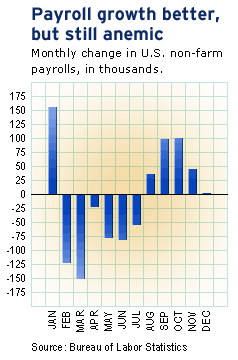
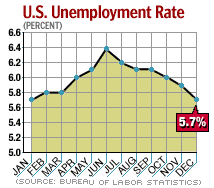
Jobs grow by just 1,000 in December, although unemployment rate drops to 5.7%.
January 9, 2004: 2:16 PM EST
By Mark Gongloff, CNN/Money Staff Writer
NEW YORK (CNN/Money) - U.S. employers expanded their payrolls -- but just barely -- in December, according to a government report Friday that fell far short of Wall Street forecasts.
Though the unemployment rate posted a surprising decline, and many economists believe the job market will improve in 2004, Friday's report probably will keep Fed policy-makers on hold and may put some political pressure on President Bush.
Payrolls outside the farm sector grew by just 1,000 jobs, the Labor Department said, compared with a downwardly revised gain of 43,000 in November. It was the fifth straight month of payroll gains. The unemployment rate fell to 5.7 percent from 5.9 percent in November.
Economists, on average, expected 148,000 new jobs and unemployment at 5.9 percent, according to Briefing.com.
"We were expecting to celebrate New Year's and instead got slapped with a pink slip," said Bill Cheney, chief economist at John HanFinancial Services.
Though it seems inconsistent for the unemployment rate to fall despite virtually no job growth in December, the two numbers are generated by separate surveys. The payroll number comes from a much broader survey of businesses, while the unemployment rate comes from a survey of households.
In recent months, the household survey has been much stronger than the business survey -- a sign, some economists think, that small businesses and start-ups are hiring -- numbers not reflected in the payroll survey. But the household survey showed a loss of 54,000 jobs last month.
What's more, 309,000 left the labor force, including those who simply stopped looking in a weak job market, which also probably helped push unemployment lower.
On Wall Street, stocks were mixed but Treasury bond prices soared, knocking yields lower, as investors bet rates aren't heading higher anytime soon.
The nation has lost 2.4 million since February 2001, just before the last recession began, the longest such stretch of pain since World War II. Nearly 800,000 of those jobs have disappeared since the recession ended in November 2001.
And while the economy grew at a blistering 8.2 percent rate in the third quarter -- and will probably grow a still healthy 4 percent or so this year -- businesses have been able to generate much of that growth by pushing their current workers harder and using technology to produce more efficiently.
Exploding productivity -- or output per worker hour -- is good news for corporate profits and for workers' wages. But it may mean a much slower job-market recovery, particularly since many employers continue to look for cheaper labor offshore.
"In a global economy, domestic demand and global supply continue to suggest ... less labor demand than usual" at home, said John Silvia, chief economist at Wachovia Securities.
Cover for Fed stance; political downer for Bush
The report seems likely to reinforce the Fed's stated desire to hold its key short-term interest rate at a 40-year low.
Despite signs inflation may pick up, some economists believe the so-called structural changes in the labor market should keep jobs relatively scarce and labor costs low, allowing the Fed to stay on hold longer.
"The much weaker-than-expected rise in payrolls truly confirms the cautious demeanor expressed by various Federal Reserve policy officials," said Anthony Chan, chief economist at Banc One Investment Advisors.
A weak job market could prove tough for President Bush as the November election approaches. When pushing for tax cuts earlier this year, Bush promised his proposals would create 300,000 jobs a month.
And more recently, Treasury Secretary John Snow suggested the economy could start adding 200,000 jobs a month as early as October 2003. So far, neither prediction has come anywhere close to true.
President Bush said that all signs pointed to strength in the economy. "I'm optimistic,'' the president told a forum on small business, according to Reuters. "All of the signs in our economy are very strong.''
Other administration officials called for making permanent the tax cuts passed in 2003.
Certainly, most economists believe stronger hiring will come in 2004, and the National Federation of Independent Business said Friday that its December survey of small businesses showed hiring plans at their strongest level since August 2000.
"To handle the rising level of spending in 2004, firms will have to increasingly rely on the addition of new workers -- job creation is about to ramp up," the NFIB said.
Wages, temp payrolls rise, but workweek shrinks
So far, however, job growth is still "a matter of faith and forecasting rather than fact," in the words of Bill Cheney at John Hancock.
In its report, the department said payrolls in service industries such as education and health care grew just 13,000 in December. Retailers lost 38,000 jobs, possibly reflecting bad weather in early December and a strike at grocery stores in California.
Temporary help payrolls rose by 30,000 jobs. Typically, this is a sign employers are gearing up to make permanent hires. But temp payrolls have risen for eight straight months without much permanent job growth.
Manufacturing shed 26,000 jobs -- the 41st straight month of falling factory payrolls.
Given strength in recent manufacturing surveys -- including the closely watched monthly survey from the Institute for Supply Management -- many economists had hoped the factory sector, which has lost 3.1 million jobs since peaking in March 1998, would finally add jobs.
Average hourly wages rose to $15.50 from $15.47 in November. But average weekly earnings actually fell $2.08 to $522.35. Wage growth is crucial for consumer spending, which fuels two-thirds of the economy.
Ominously, the average work week shrank to 33.7 hours from 33.9 in November, indicating businesses decreased activity.
And the percentage of private firms adding to payrolls also fell from November's three-year high. The November reading had fueled hope for a broad-based improvement in the labor market.
Find this article at:
http://money.cnn.com/2004/01/09/new.../jobs/index.htm |
|
|
|
| rizen |
senior bush: its the econmy stupid
current bush: its the jobs stupid
:conf: |
|
|
| DaveSaenz |
http://www.nytimes.com/2004/01/10/b.../10jobs.html?th
| quote: | Bush Seeks Ways to Create Jobs, and Fast
By EDMUND L. ANDREWS
Published: January 10, 2004
Growth in Jobs Came to a Halt in December (January 10, 2004)
WASHINGTON, Jan. 9 - The stage had been set to celebrate the revival of jobs.
With a phalanx of women entrepreneurs at his side and a billboard covered with the word "Jobs!" behind him, President Bush proclaimed his confidence about the economy here on Friday. But he made only passing reference to the latest news about employment.
The reason was clear: Friday's report on unemployment in December was much weaker than either the administration or most independent economists had predicted. Job creation was virtually nil, and the unemployment rate declined only because the labor force shrank by 309,000 workers. Many of those were people who had simply become too discouraged to keep looking for work.
The problem confronting Mr. Bush is that there is little he can do between now and the elections except wait and hope that the employment picture improves. And the administration is not likely to get much more help from the Federal Reserve, which has already reduced short-term interest rates to just 1 percent.
"In terms of big levers to pull, they don't have anything," said Pierre Ellis, a senior economist at Decision Economics, a forecasting company.
It is entirely possible that the job trend will abruptly improve over the next several months. Businesses are more optimistic and more willing to invest in expansion than they have been in years, and that should translate into more jobs at some point.
President Bush may also have an ace in the hole. Last year's tax cuts are expected to produce another big bulge of tax refunds and lower tax bills between now and June - about $40 billion in extra cash flow to households, according to economists at Goldman Sachs and Macroeconomic Advisers.
"It's not a good idea to give excessive weight to any particular statistic," said N. Gregory Mankiw, chairman of the White House Council of Economic Advisers. "If you look at the pattern, most of the economic news has been good rather than bad."
Both the White House and the Fed are confronted by a recovery unlike any other in modern history. Economic growth has been soaring for months, corporate profits have shot up and the stock market has regained much of its old ebullience.
Yet job creation has been slower than in almost any previous recovery, and wage growth has slowed to a crawl. That appears to reflect another big new element that lies entirely outside the president's control: the enormous increases in productivity, which have made it possible for companies to squeeze more output from each worker.
"The evidence is powerful that we can have 4 or 5 percent growth without hiring much," said John Makin, a senior economist at the American Enterprise Institute. Mr. Makin has long been among the more pessimistic economic forecasters, but the employment and wage data on Friday came in far worse than even he had expected. "I was stunned, quite frankly," he said.
It is not unusual for presidents to undertake actions to straighten out the economy and then do little but hope and pray they work - and in time. Jimmy Carter appointed Paul A. Volcker as chairman of the Fed, and he increased interest rates to stem inflation. The first President Bush reluctantly raised taxes to deal with a ballooning budget deficit. In each case, those actions helped the economy recover, but not in time to earn Mr. Carter or Mr. Bush a second term.
Administration officials know that the crucial issue in an election season is jobs. And President Bush's track record, a net loss of more than two million jobs since he took office, remains one of his biggest political weaknesses.
Not surprisingly, Mr. Bush's Democratic opponents jumped on the jobs number as another opportunity to attack his record.
"President Bush has all but declared 'Mission Accomplished' on an economy that is still not generating jobs," said Gen. Wesley K. Clark. Howard Dean, who has distanced himself from former President Bill Clinton through much of his campaign, said Mr. Bush had generated only 1,000 jobs in December while the economy added about 1,000 jobs every three hours during Mr. Clinton's administration.
"What further proof do we need that George Bush's economic policies are a failure for working Americans?" Mr. Dean said in a statement issued after the new employment data was released.
Unable to do much more to stimulate the economy, administration officials have stepped up their arguments that the three tax cuts over the last three years have made the economic slowdown and job losses shorter and smaller than they might otherwise have been.
"Without the passage of the president's plans, by the second quarter in 2003, the unemployment rate would have been nearly one percentage point higher," Treasury Secretary John W. Snow said earlier this week. "As many as 1.5 million fewer Americans would be working, and real G.D.P. would have been as much as 2 percent lower."
It is impossible to prove or disprove such contentions, but they are unlikely to comfort voters in big industrial states where hundreds of thousands of manufacturing jobs have been lost over the last three years.
Administration officials also appear to have stepped up efforts to show their concern, sometimes by criticizing "unfair trade practices" by China and other countries and occasionally by offering help in prominent cases.
On Thursday, for example, the Export-Import Bank announced a new agreement to lend $35 million to Malden Mills, a textile company in Massachusetts whose owners have been trying to pull it out of bankruptcy court.
However well intentioned, such moves amount to little more than window dressing. "If they want to do something for public relations, they might have some kind of job hiring incentive," Mr. Ellis of Decision Economics said. "But it could not possibly be something of a magnitude that would affect this economy." |
|
|
|
| DaveSaenz |
http://www.latimes.com/services/sit...tered.intercept
| quote: | Jobless Count Skips Millions
The Rate Hits 9.7% When the Underemployed and Those Who Have Quit Looking are Added
by David Streitfeld
SAN FRANCISCO — Lisa Gluskin has had a tough three years. She works almost as hard as she did during the dot-com boom, for about 20% of the income.
When Gluskin's writing and editing business cratered in 2001, she slashed her rates, began studying for a graduate degree and started teaching part time at a Lake Tahoe community college for a meager wage.
The industries that were expanding in the late '90s, including computer and professional services, paid well.
Those industries are in retreat. So is manufacturing, a traditional source of high wages. On the rise, meanwhile, are lower-paying service jobs.
During the boom, it was easy to trade up. Now it's just as easy to trade down.
It's been a fragmented, hand-to-mouth life, one that she sees mirrored by friends and colleagues who are waiting tables or delivering packages. In the late '90s, the 35-year-old Gluskin says, "we had careers. We had trajectories. Now we have complicated lives. We're not unemployed, but we're underemployed."
The nation's official jobless rate is 5.9%, a relatively benign level by historical standards. But economists say that figure paints only a partial — and artificially rosy — picture of the labor market.
To begin with, there are the 8.7 million unemployed, defined as those without a job who are actively looking for work. But lurking behind that group are 4.9 million part-time workers such as Gluskin who say they would rather be working full time — the highest number in a decade.
There are also the 1.5 million people who want a job but didn't look for one in the last month. Nearly a third of this group say they stopped the search because they were too depressed about the prospect of finding anything. Officially termed "discouraged," their number has surged 20% in a year.
Add these three groups together and the jobless total for the U.S. hits 9.7%, up from 9.4% a year ago.
No wonder the Democratic presidential candidates have seized on jobs as a potentially powerful weapon.
Howard Dean criticized President Bush for "the worst job creation record in over 60 years." Richard Gephardt said that "I have three goals for my presidency: jobs, jobs, jobs." John Kerry said "the first thing" he'd do as president would be to fight his "heart out" to bring back the jobs that have disappeared in recent years.
Bush, meanwhile, is quick to seize credit where he can. When the unemployment rate for November fell one-tenth of a point, he went out immediately to give a speech at a Home Depot in Maryland.
"More workers are going to work, over 380,000 have joined the workforce in the last couple of months," Bush said. "We've overcome a lot."
A number of economists say it's a mistake to evaluate the job market solely by talking about the official unemployment rate. It's a blunt instrument for assessing a condition that is growing ever more vague.
"There's certainly an arbitrariness to the official rate," says Princeton University economics professor Alan Krueger. "It irks me that it's not put in proper perspective."
On Jan. 9, when the rate for December is announced, both Republicans and Democrats will assuredly again maneuver for advantage — precisely because the number isn't expected to change much.
"At this point, where we don't know which way it's going but it isn't likely to be going far, both sides will try to use it," says Michael Lewis-Beck, a political scientist at the University of Iowa.
In every election since 1960, the party in the White House lost when the unemployment rate deteriorated during the first half of the year. If the rate improved, the party in the White House won.
That's not a coincidence, says Lewis-Beck, who has edited several volumes on how economic conditions determine elections. "People see the president as the chief executive of the economy," he says. "They punish him if things are deteriorating and reward him if things are improving."
By any normal standard, things should have been improving on the employment front long before this point. More than 2 million jobs have been lost in the last three years, a period that encompassed a brief, nasty recession and a recovery that was anemic until recently. Even in the best-case scenario, Bush will end this term with a net job loss. That hasn't happened to a president since Herbert Hoover at the beginning of the Depression.
Many economists are mystified about why a suddenly booming economy is producing so few jobs.
"We're all sitting there and saying, 'When are they going to return?' " says Richard B. Freeman, director of the labor studies program at the National Bureau of Economic Research. "It's looking a little better, but we don't understand why it isn't looking a lot better. Why shouldn't Bush be sitting there saying, 'Man, I'm sitting pretty. This is a great boom'?"
One statistic proving particularly perplexing is the percentage of the adult population that is employed. This number rises during good times, as people are lured into the workforce, and falls during recessions as companies falter.
True to form, the percentage of adult Americans with jobs dropped from a high of 64.8% in April 2000, just as the stock market was cresting, to 62% in September — the lowest level in a decade. If past recessions are any guide, those 5 million people who found themselves jobless should have driven the unemployment rate up to about 8%.
Instead, the rate never went much above 6%.
"More than half of the additional people who would have reported themselves as unemployed in a previous big recessionary period … aren't," a puzzled UC Berkeley economist, Brad DeLong, wrote on his website. "They're reporting themselves as out of the labor force instead."
"Out of the labor force" means you're not working for even one hour a week and don't want to, either. It's the traditional category for students, married women with young children, flush retirees and idle millionaires.
A new way that people seem to be joining this category is by getting themselves declared disabled. This designation makes them eligible for government payments while removing them from the unemployment rolls.
From 1983 to 2000, economists David Autor and Mark Duggan wrote in a recent study, the number of non-elderly adults receiving government disability payments doubled from 3.8 million to 7.7 million.
The scholars present a case that the sharp increase isn't because the workplace suddenly became more dangerous. Instead, it has been prompted by liberalized screening policies, which make it possible to claim disabled status for, say, several small impairments as opposed to one big injury. Government examinations also have been downplayed in favor of the disabled's own medical records and the pain he or she claims to be experiencing.
At the same time, benefits have been sweetened. As a result, millions of individuals who lost jobs now have an attractive — and permanent — alternative to searching for work.
Autor and Duggan concluded that if disability payments weren't so appealing, many more people would be unemployed, boosting the jobless rate two-thirds of a point.
Another way in which people forgo an appearance on the unemployment rolls is if they decide to go into business for themselves. There are 9.6 million people who say they are self-employed full time, a number that rose 118,000 last month. Without the recent increase in self-employed, the jobless number would look much worse.
Many others may be working for themselves part time, temporarily, as a way to get food on the table in the absence of better options.
Take Steve Fahringer, who until recently was working for a Bay Area marketing agency that cut 20% of its employees and trimmed the wages of the remainder by 20%. Fahringer didn't particularly like his job. Because the recession supposedly was history, he thought he could find a new position. The 34-year-old didn't think it would be easy, but he thought it possible. So he quit.
"I left July 1," he says. "I haven't found a new job yet."
It's a common problem. The segment of the labor force that has been jobless for more than 15 weeks has risen nearly 150% since 2000. The current level is the highest since the recession of the early 1990s. Nearly one-quarter of the jobless have been unemployed for longer than six months.
In Fahringer's case, he spent some time aggressively looking for a job, which made him part of the official July unemployment rate of 6.2%. Then he stopped looking, which meant that he was one small reason the rate started going down.
Instead of unemployed, Fahringer was classified as "discouraged." A little more than 8% of the people who want a job in the Bay Area are estimated by the Bureau of Labor Statistics to be discouraged, slightly higher than Los Angeles/Long Beach but lower than the battered technology center of San Jose.
Discouraged workers have never been included in unemployment rates, although they came close the last time a commission met to reform the system, a quarter of a century ago. "It was a very hot issue," remembers Glen Cain, a retired economist who was a commission member. He says the conservatives on the panel, who felt that anyone who really wanted a job should be out there hustling no matter what, prevailed.
Fahringer found an alternative way to earn a bit of money. He did some acrylic paintings, which he sold for a total of $1,000. He calls himself "a hobbyist," which means for a while he moved out of the labor force entirely.
Now he's a temp, assigned by his agency to a nonprofit office. For the first time in six months, he's working 40 hours a week. By the government's accounting, he has once again joined the ranks of the employed. But from the standpoint of his wallet, Fahringer is worse off: He's earning less money, with no paid holidays, no sick leave, no pension plan, no health insurance, no future.
The Economic Policy Institute, a liberal-leaning Washington think tank, says Fahringer's situation is in many ways typical. The industries that were expanding in the late '90s, including computer and professional services, paid well.
Those industries are in retreat. So is manufacturing, a traditional source of high wages. On the rise, meanwhile, are lower-paying service jobs.
During the boom, it was easy to trade up. Now it's just as easy to trade down.
Fahringer's solution: Opt out.
"I'm thinking of going back to school," he says. "I'd take out a loan." That would put him out of the labor force again.
In some eyes, a nation of burger flippers, temps and Wal-Mart clerks isn't the worst scenario for the economy. The worst is that companies continue to eliminate jobs faster than they create them, setting up a game of musical chairs for the labor force.
That prospect alarms Erica Groshen, an economist with the Federal Reserve Bank of New York. "If you plot job losses versus gains on a chart, it's shocking," she says.
Losses are running at about the same rate they were in 1997 and 1998, two good years for the economy. But job creation in the first quarter of 2003 — the most recent period available — was only 7.4 million, the lowest since 1993.
"If this goes on too long, you'd have to worry there's something fundamentally wrong," Groshen says. Although the economy has picked up since March, "so far I haven't seen anything that suggests job creation is picking up."
That bodes poorly for Ian Golder. His last full-time job was with a start-up publication that wrote about venture capital.
Two years ago, Golder was laid off. It was the first time since he graduated from UC Berkeley 14 years earlier that he didn't have steady work.
Golder looked for a while, gave up for a while, then landed a contracting gig with no benefits proofreading for a chip maker. When that ran out, he worked 20 hours a month on a financial services newsletter.
His wife, Heather, a recent graduate in English from UC Davis, also was without a job. They thought about selling their house in Sacramento and moving, but prospects didn't look any better anywhere else. To make ends meet, they took in two boarders.
At the beginning of December, things seemed to improve a bit. Golder got a job in the document-control department of a medical devices company. The department, he was told, used to have 20 full-time people. Now it has five, plus four temps.
The job will last two months. After that, who knows?
"Optimists say things will be better then," Golder says. "But a full-time position with benefits seems pretty remote."
Copyright 2003 Los Angeles Times |
|
|
|
| smokeape |
Makes me glad I still got a job.
Advances in factory automation and the computer age are cutting out more jobs since fewer people can do the same amount of work. Coupled with open markets with countries with cheap, poverty level labor, no wonder things are tough.
There's always the bright side though. We're conversing back and forth on computers, eh? How many folks in third world countries can do that like us?
{{{smoke}}} |
|
|
|
|

